

Our Work
Bluu Publishing helps subject-matter experts, content creators, entrepreneurs launching educational offerings, and organizations turn expertise into learning that works. We design and refresh courses, build clean LMS shells, and craft curricula, rubrics, and templates—grounded in learning science and measurable outcomes, applying andragogy for professionals and age-appropriate pedagogy for youth. The projects below highlight our process and deliverables across higher education and youth programs. We also design workforce-training modules and full courses for agencies and organizations. Some work is anonymized for confidentiality; no student data is displayed.
01
Leadership Course (Canvas) — Welcome & Discussion Framework (Anonymized)
Contracted as the instructor to revamp and rebuild a leadership course in Canvas using adult-learning principles. I created a neutral banner, a clear Welcome/Start Here + Module 1 pattern, and an outcomes-aligned discussion (Culturally Proficient Leadership Profile) with explicit objectives, a structured six-part prompt, and submission/peer-engagement guidelines. The shell was delivered and ready to run; the term was later canceled for low enrollment (no student UX data). All institutional identifiers are anonymized; no student data displayed.
What’s shown (in order):
-
Anonymized course banner
-
Canvas Modules: Welcome/Start Here + Module 1
-
Discussion: Objectives & Prompt
-
Discussion: Peer Engagement & Submission Guidelines

Neutral course banner used to brand the Canvas shell; institution details removed.

Welcome/Start Here layout with course overview, Q&A, expectations, and Module 1 structure; institution details removed.

Canvas discussion requirements outlining word count, due dates, and peer-reply expectations (identifiers removed).
Neutral course banner used to brand the Canvas shell; institution details removed.
02
Embark — Charting Your Course to Entrepreneurship (Thinkific Build)
Developed as an original course offering under Bluu Publishing, this project highlights the design and build of Module 1 from Embark, a project-based entrepreneurship course created in Thinkific. Designed for teens and emerging entrepreneurs, Embark introduces learners to the entrepreneurial mindset and guides them through identifying opportunities, testing assumptions, shaping brand concepts, and communicating value through confident pitches.
While this version of the course is presented in a self-paced format, it was intentionally structured to support both asynchronous and live-cohort delivery. The design emphasizes measurable outcomes, Universal Design for Learning (UDL) principles, and practical, real-world application. Features include scaffolded modules, interactive discussions, and authentic assessments such as the Problem-Solving Matrix and Business Ideation project. Visual design aligns with Bluu’s brand identity while maintaining a clean, learner-centered interface.
What’s shown (in order):
-
Course landing page and banner
-
Course landing page and About section
-
Curriculum overview with modular structure
-
Lesson overview with objectives and guidance
-
Assignment: Problem-Solving Matrix
-
Assignment: Evaluation criteria and integrity guidelines
-
Discussion board prompt for peer interaction
-
Module wrap-up page summarizing key takeaways

Branded Thinkific landing page showcasing course title, audience, and call-to-action.
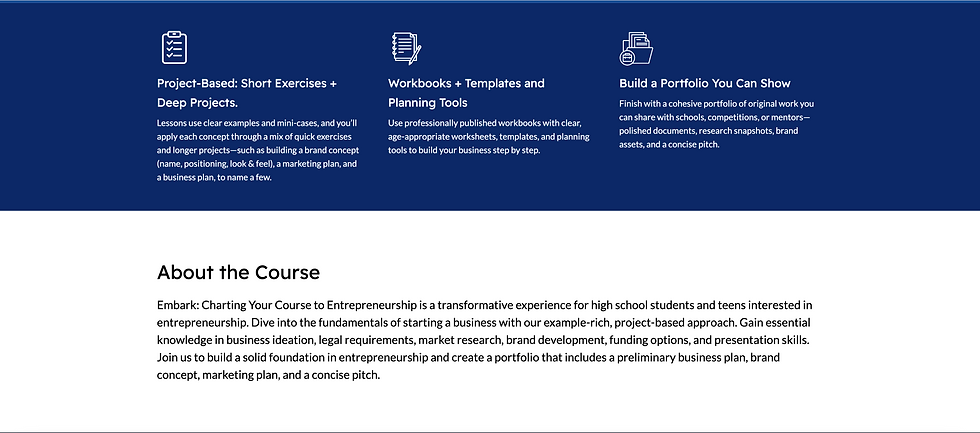
“About the Course” section emphasizing project-based learning and teen entrepreneurship.

Module wrap-up screen summarizing key skills developed and next steps in the learning path.
Branded Thinkific landing page showcasing course title, audience, and call-to-action.
03
Course Audit & Redesign: Cultural Competence Leadership Course (Canvas Build)
This project demonstrates my process for auditing and redesigning an inherited graduate-level course to improve alignment, clarity, and learner engagement. The original syllabus contained strong conceptual ideas but lacked measurable outcomes and clear pathways between learning objectives, activities, and assessments.
Using my expertise in adult-learning theory and Quality Matters principles, I restructured the course to ensure that every learning outcome connected to practical, assessable evidence of understanding. This included rewriting vague outcomes, scaffolding modules, and creating transparent rubrics that define success from the learner’s perspective.
Although the revised course was not ultimately launched due to low enrollment, the completed redesign reflects a full, ready-to-run course model—fully aligned, measurable, and guided by best practices in adult learning.
Through this redesign, I emphasized the three questions every adult learner subconsciously asks:
What am I learning? Why does it matter? and How will I use it?
By aligning instruction around these questions, I built a course experience that not only met learning standards but also made relevance and application visible—helping learners connect theory to leadership practice.
What’s shown (in order):
-
Excerpt from the original syllabus showing vague and unmeasurable outcomes
-
Reworked Course Learning Outcome (CLO #4) demonstrating measurable and Bloom-aligned language
-
Alignment snapshot linking outcome, module, assessment, and evidence of learning
-
Rubric excerpt (Culturally Proficient Leadership Profile) — criteria + performance levels

Excerpt of original syllabus with vague outcomes and misalignment.

Excerpt showing reworked CLO for clarity and measurement.

Excerpt from rubric defining criteria and proficiency levels.
Excerpt of original syllabus with vague outcomes and misalignment.
04
Instructor Training & Support Toolkit — Scalable Enablement & Quality Loop
Developed under Bluu Publishing, this project showcases a practical, scalable toolkit that equips instructors—from content creators and SMEs to organizational trainers—with the resources they need to teach effectively and sustain quality over time. The toolkit integrates quick-reference job aids, facilitation best practices, real-time engagement strategies, and a mid-course feedback loop to strengthen instructional delivery and learner experience.
Built to support both individual creators and enterprise teams, the framework emphasizes measurable outcomes, adult learning principles, accessibility, and continuous improvement. Each resource is modular, adaptable, and ready for use across self-paced, live, or hybrid learning environments. Designed with long-term sustainability in mind, these materials combine instructional precision with real-world usability.
What’s included:
-
Instructor Training & Support Overview: A four-phase framework (Orientation, Facilitation Prep, Live Delivery, Reflection) outlining key focus areas and deliverables such as LMS walkthroughs, facilitation guides, and improvement checklists.
-
Facilitation Guide (excerpt): Clear, actionable best practices for presence and communication, discussion design, and inclusive facilitation across diverse learner needs.
-
Live Delivery Technique — Poll → Pivot → Reflect: A simple, high-impact engagement strategy that helps instructors collect instant feedback, adapt content in real time, and reinforce learner investment.
-
Mid-Course Feedback Loop: A practical, midstream feedback process that promotes transparency, builds learner trust, and drives continuous course improvement.
What’s shown (in order):
-
Overview of the four-phase instructor support model
-
Facilitation Guide — best-practices excerpt
-
Live Delivery — Poll → Pivot → Reflect technique
-
Mid-Course Feedback Loop — continuous improvement process

Excerpt from Instructor Feedback & Quality Assurance Toolkit

Excerpt from Instructor Feedback & Quality Assurance Toolkit

Excerpt from Instructor Feedback & Quality Assurance Toolkit
Excerpt from Instructor Feedback & Quality Assurance Toolkit